

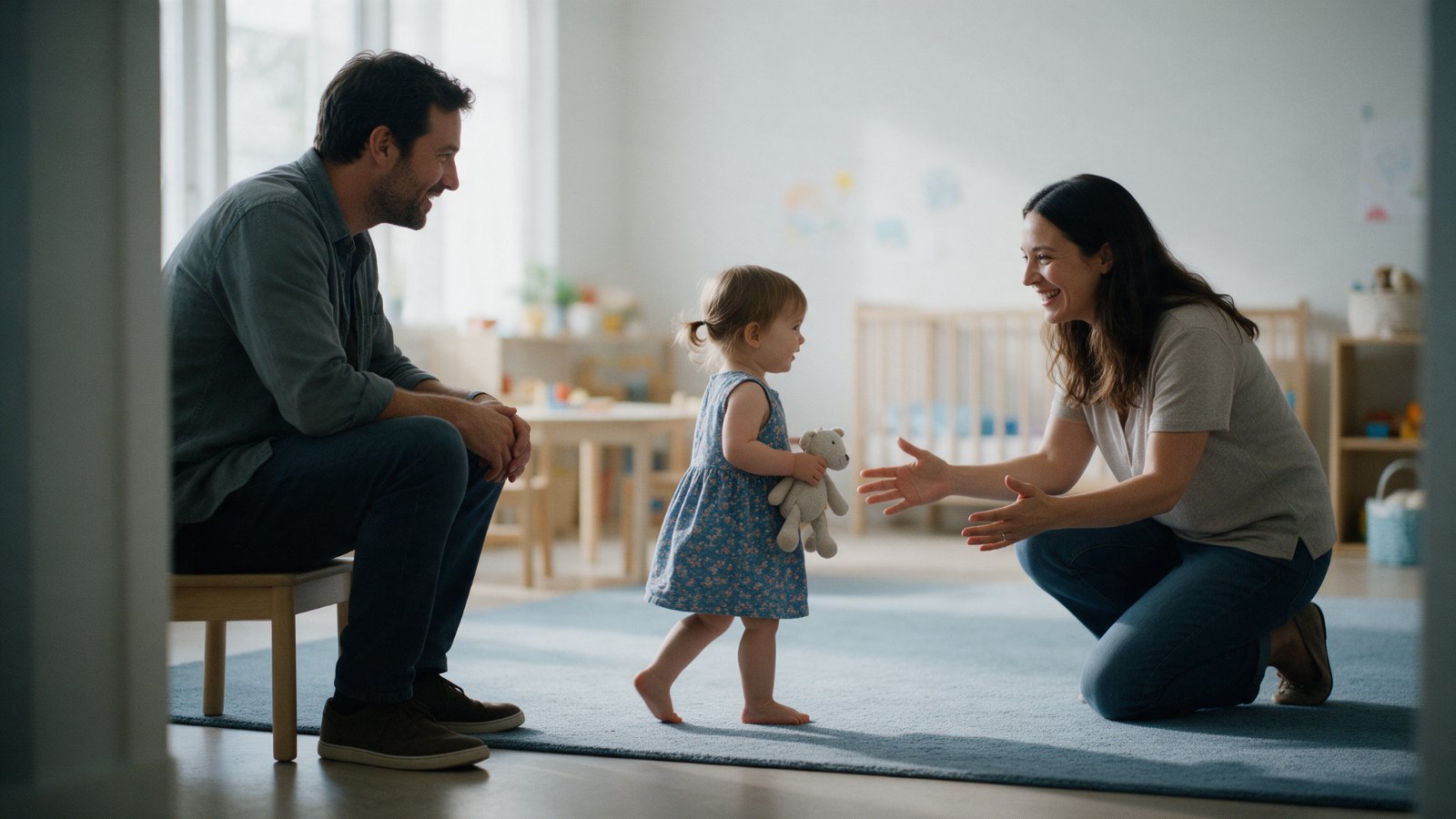
Why toddlers often prefer one parent, especially at bedtime and goodbyes, why it is a normal phase and not a rejection, what helps both the favorite and the other parent, and when to talk to your pediatrician.
"No, Mommy do it!" For weeks your toddler has wanted only one parent: for bedtime, for the car seat, for a scraped knee. The favorite is exhausted and feels guilty, the other parent feels pushed away, and both wonder what they did wrong.
Most of the time, nothing. A strong preference for one parent is common in toddlers and usually passes. This guide explains why it happens, what helps each of you, and when it is worth talking to your pediatrician.
Key takeaways
- Preferring one parent is a normal, temporary phase, not a rejection of the other parent.1
- It often shows most at night and at goodbyes, when separation anxiety is at work.2
- Toddlers build attachment relationships with both parents, and both bonds matter.4
- Share routines, keep goodbyes short and warm, and talk to your pediatrician if anxiety disrupts sleep, mood or health.1
Why toddlers pick a favorite
Toddlers are learning that the people they love can leave and come back. Separation anxiety usually peaks around one to two years.1 In this stage a child may wake at night and cry for one or both parents, often with a strong preference for one.2 The favorite is often the person the child spends the most time with, because favoritism is rooted in attachment and a sense of safety.1
Preferences also shift. A new sibling, starting daycare, a move or a parent working longer hours can tip a child toward one parent for a while, and in many families the favorite changes more than once.
What helps if you are the favorite
- Hand over, don't take over: let the other parent do the bath, the story or breakfast on set days, even if there are tears at first.
- Stay warm, then step back: say "Daddy is doing bedtime tonight, I'll see you in the morning" and leave calmly. Long goodbyes make it harder.3
- Speak well of the other parent: children notice how you talk to each other. Show that you enjoy being together and remind your child you both love them.1
- Look after yourself: being needed all the time is tiring. Use the other parent's turns to rest.
What helps if you are the other parent
- Don't take it personally: try not to show hurt. Your child is not rejecting you; they are leaning on what feels most familiar.1
- Keep showing up: keep offering comfort and play, even when it is refused. Being consistent builds trust.3
- Create your own ritual: a special song, a morning walk or a game only the two of you play.
- Explain before you step in: tell your child what is happening ("Mommy is at work, so I'm here for your bath") instead of surprising them.1
What the research says
An individual participant data meta-analysis pooled 9 studies with 1,097 children, on average about 28 months old, whose attachment had been assessed with both their mother and their father. Children with an insecure attachment to one or both parents were at higher risk of elevated internalizing problems than children securely attached to both, and the mother-child and father-child relationships may not differ in how much they contribute.4
In other words, this week's favorite does not mean one bond counts less. Both relationships help a child feel secure.
Bedtime, goodbyes and daycare
The preference often shows most at bedtime and at drop-off. Quick goodbye rituals, honest words ("I'll be back after your nap") and keeping your promise help children cope.3 Peek-a-boo and short, practiced separations show young children that you always come back.5 Let your child's educators know about the phase: they see your child after every goodbye and can tell you how quickly they settle.
When to talk to your pediatrician
Separation anxiety is common between 6 months and 3 years, and most children grow out of it.5 Talk to your pediatrician if your child's anxiety is significantly disrupting their behavior, mood, sleep or overall health,1 if it has been going on for more than a few weeks and worries you,5 or if anything else about your child's development concerns you.
How kidsday helps
During a clingy phase, small updates from daycare reassure the whole family. In the kidsday parent app, parents receive daily updates with photos, activities, meals, naps and notes, and can message the center directly, so whoever does pick-up today already knows how the day went.
Final thoughts
Being the favorite is tiring, and being the other parent can hurt. Both are part of a normal phase. Share the routines, keep goodbyes short and warm, keep showing up, and your toddler will most likely widen the circle again.
Sources
- The Sydney Children's Hospitals Network (NSW Health). Social and emotional development for toddlers. Kids Health Hub. schn.health.nsw.gov.au
- American Academy of Pediatrics, HealthyChildren.org. Separation Anxiety & Sleeping Trouble in Young Children, 2022. healthychildren.org
- Swanson WS. How to Ease Your Child's Separation Anxiety. American Academy of Pediatrics, HealthyChildren.org, 2026. healthychildren.org
- Dagan O, Schuengel C, Verhage ML, et al. Configurations of mother-child and father-child attachment as predictors of internalizing and externalizing behavioral problems: An individual participant data (IPD) meta-analysis. New Directions for Child and Adolescent Development, 2021. doi.org/10.1002/cad.20450
- NHS. Separation anxiety. nhs.uk