
A practical guide for daycare directors and educators: the key handwashing moments, the five steps, how to teach toddlers a routine, where hand sanitizer fits, and what trials in daycare centers found.
Every winter the pattern repeats: one runny nose in the toddler room on Monday, five by Thursday, and half the team coughing by Friday. Daycares can't stop every cold, but one routine makes a measurable difference and costs almost nothing: handwashing at the right moments, done the right way, every day.
This guide for directors and educators covers when to wash, how to teach toddlers a routine they can follow, where hand sanitizer fits, and what the research shows.
Key takeaways
- Wash at fixed moments of the day: on arrival, before and after eating, after the toilet or a diaper change, after nose-blowing and after outdoor play.
- Scrub for at least 20 seconds with soap and running water, then rinse and dry with a clean towel.1
- In a trial in 24 daycare centers, a hand hygiene program using sanitizer cut respiratory infections and antibiotic prescriptions compared with no program.3
- Young children can use hand sanitizer only with an adult watching.2
When to wash hands in daycare
Tie handwashing to the routine rather than to reminders, so it happens even on busy days. Based on CDC guidance,1 the key moments in a daycare are:
- On arrival, before children join the group.
- Before and after meals and snacks, and before and after preparing food.
- After using the toilet, and after every diaper change (educators wash their own hands and the child's).
- After blowing or wiping a nose, coughing or sneezing into hands.
- After outdoor play, sand and messy play, after touching animals or garbage, and after cleaning up vomit or diarrhea.
How to wash properly
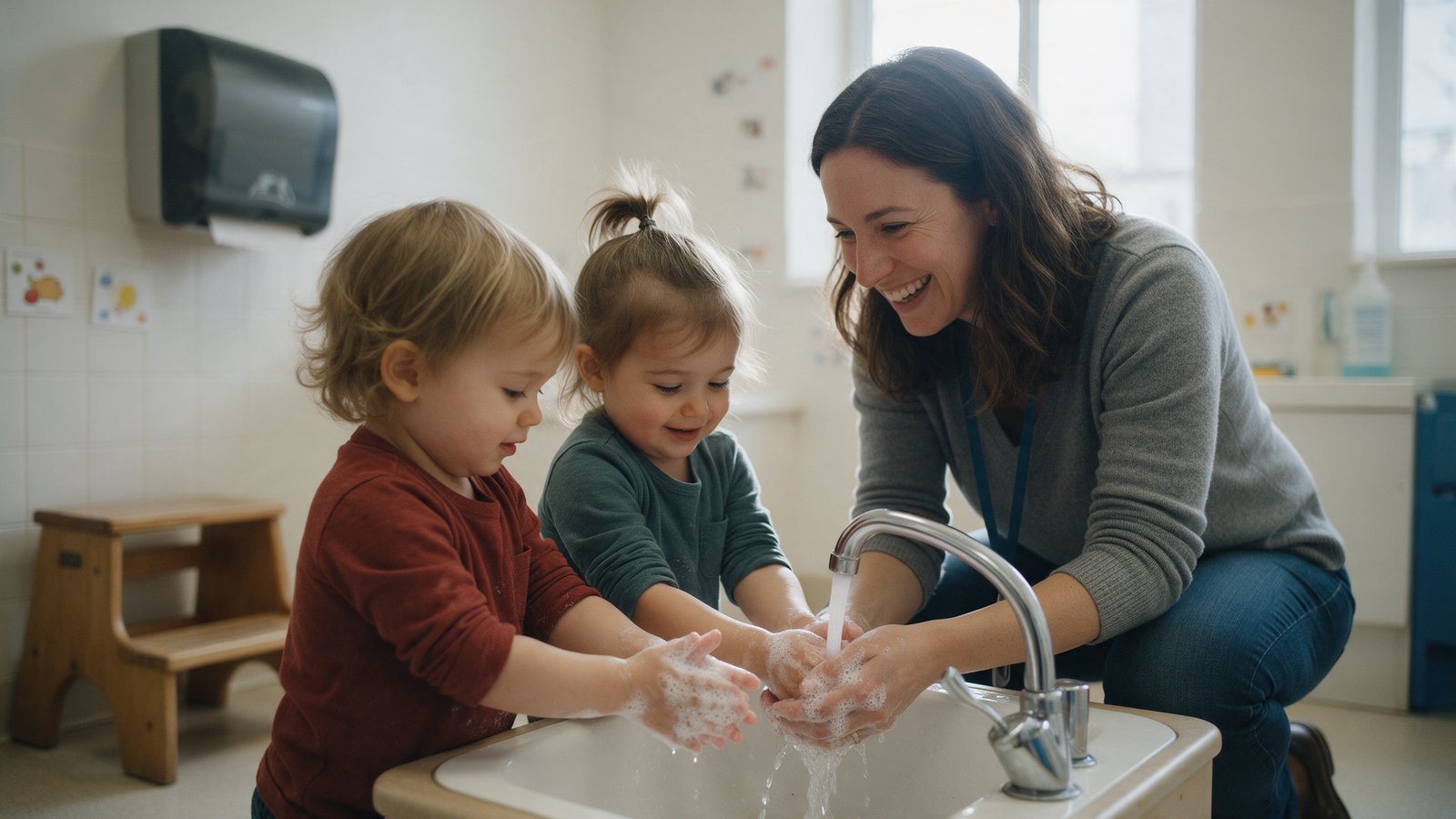
The CDC's five steps work for children and adults alike:1
- Wet: hands under clean running water, warm or cold, then apply soap.
- Lather: rub hands together to build a lather, including the backs of the hands, between the fingers and under the nails.
- Scrub: for at least 20 seconds. For children, that is about two rounds of a short song.
- Rinse: well under clean running water.
- Dry: with a clean paper towel or an air dryer. Avoid shared cloth towels in group rooms.
What the research says
A cluster randomized trial in 24 daycare centers in Almería, Spain, followed 911 children aged 0–3 for eight months. Centers received hand hygiene education for staff, families and children, using either soap and water or hand sanitizer. Compared with the control group, the sanitizer group had a lower rate of respiratory infections (incidence rate ratio 0.77) and of antibiotic prescriptions (0.69), and fewer days absent.3
A systematic review of 18 cluster randomized trials in schools and child day care found that hand hygiene programs may reduce absence and respiratory infections; the effect on stomach bugs was less clear.4
How to teach toddlers a handwashing routine
- Make it visible: a picture sequence of the steps at child height next to every sink.
- Model it: wash your hands with the children, every time, and name each step out loud.
- Use a song or a count: a short handwashing song makes 20 seconds feel shorter and gives children a clear end point.
- Set up the sink for small hands: a sturdy step, soap they can reach and paper towels within arm's length.
- Wash in small groups: three or four children at a time instead of a queue of twelve, so nobody rushes.
- Involve families: share the song and the picture steps with parents so the same routine happens at home. Praise the routine, not perfection: toddlers learn by repetition.
Where hand sanitizer fits
Soap and water is the best way to remove all types of germs. When they aren't available, for example on an outing, the CDC recommends an alcohol-based sanitizer with at least 60% alcohol, for hands that are not visibly dirty.2 Young children should use it only with an adult supervising, so they don't swallow it, and bottles belong out of children's reach. If a child is often unwell, families should talk to their pediatrician; educators observe and record, they don't diagnose.
How kidsday helps during cold and flu season
Good hygiene works best when educators and families share what they see. In kidsday, educators record health observations, toilet routines and incidents in one place, and parents receive daily updates with photos, activities and notes through the parent app. Messaging between parents and the center happens in the app, so a short note about a new handwashing song, or a reminder to keep a child home when unwell, reaches every family quickly.
Final thoughts
Handwashing won't make your center illness-free, but it is cheap, safe and backed by trials in daycare settings. Fix the moments in your routine, teach the five steps with pictures and a song, wash with the children, and bring families on board.
Sources
- Centers for Disease Control and Prevention (CDC). About Handwashing (when and how to wash your hands). cdc.gov/clean-hands
- CDC. Hand Hygiene Frequently Asked Questions; and Hand Sanitizer Use Out and About. cdc.gov/clean-hands/faq; stacks.cdc.gov/view/cdc/106061
- Azor-Martinez E, et al. Effectiveness of a Hand Hygiene Program at Child Care Centers: A Cluster Randomized Trial. Pediatrics, 2018. pubmed.ncbi.nlm.nih.gov/30297500
- Willmott M, et al. Effectiveness of hand hygiene interventions in reducing illness absence among children in educational settings: a systematic review and meta-analysis. Archives of Disease in Childhood, 2016. pubmed.ncbi.nlm.nih.gov/26471110