
20 easy, hands-on preschool activities for 3–5 year olds using everyday materials, grouped by developmental area, with what children learn from each.
Children aged three to five learn best with their hands, their bodies and their curiosity. They want to pour, stack, sort, build, splash and pretend, and every one of those actions builds language, thinking, movement and social skills at the same time. The challenge for busy educators and parents is finding fresh ideas that do not require special equipment or a big budget.
This list brings together 20 hands-on activities you can set up with materials you probably already have: paper, cardboard boxes, clothes pegs, cups, water, leaves and playdough. Each idea is grouped by developmental area, with a short note on what you need and what children learn. Use them in the classroom, at home, indoors or outside.
Before You Start: A Quick Safety Note
- Always supervise: stay close during water play, cutting and any activity with small parts.
- Watch for choking hazards: avoid very small objects such as beads, buttons, dried beans or bottle caps with younger children or any child who still puts things in their mouth.
- Check materials: use child-safe scissors, non-toxic paint and glue, and clean, undamaged recycled items.
- Know your group: consider allergies (for example, to certain foods used in sensory play) and adapt each activity to the children's age and abilities.
Language and Literacy
- 1. Story basket: fill a basket with a few everyday objects (a spoon, a sock, a toy car) and invite children to pull one out and add it to a story you build together. Children practice vocabulary, sequencing and imagination.
- 2. Cardboard box puppet theatre: cut a window in a large box and use paper bag or sock puppets to act out favorite stories. This builds speaking confidence, listening and retelling skills.
- 3. Letter hunt in sand or flour: hide cardboard letters in a tray of sand or flour and ask children to find and name them, or find the first letter of their name. They practice letter recognition in a playful, sensory way.
Early Math
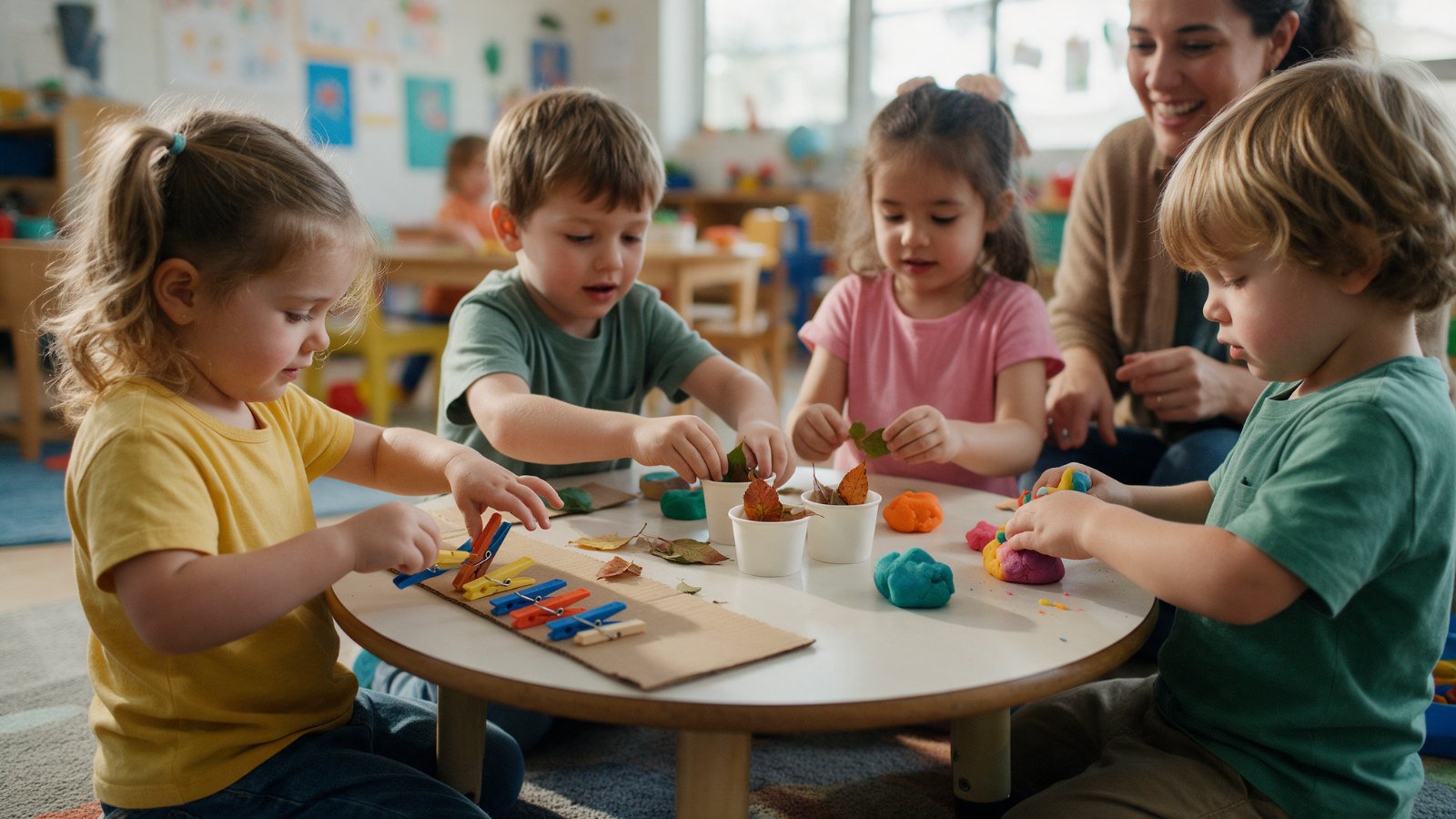
- 4. Peg counting cards: write numbers on strips of cardboard and ask children to clip the matching number of clothes pegs onto each one. They connect numerals with quantities while strengthening finger muscles.
- 5. Sorting collections: gather leaves, lids, spoons or toy blocks and sort them by color, size or shape into muffin tins or cups. Children learn to classify, compare and explain their thinking.
- 6. Cup tower patterns: use paper or plastic cups in two colors to build towers with repeating patterns (red, blue, red, blue). This introduces patterns, counting and early problem-solving.
Fine Motor Skills
- 7. Playdough tools: offer playdough with rolling pins, cookie cutters and plastic knives. Squeezing, rolling and cutting build hand strength needed for drawing and writing later.
- 8. Tearing and sticking collage: let children tear colored paper or old magazines into pieces and glue them onto a shape. Tearing builds finger control and coordination.
- 9. Threading with pasta and string: thread large tube-shaped pasta onto a shoelace or thick string to make necklaces. Children practice hand-eye coordination, concentration and patterns.
Gross Motor Skills
- 10. Cardboard box obstacle course: set up boxes to crawl through, cushions to step on and a line of tape to balance along. Children build strength, balance and body awareness.
- 11. Paper plate skating: on a smooth floor, children stand on two paper plates and slide their feet as if skating. This develops coordination and leg strength, and it is great fun.
- 12. Animal moves: call out animals and move like them: hop like a frog, stomp like an elephant, slither like a snake. Children practice different movements, listening and following instructions.
Science and Nature
- 13. Sink or float: fill a tub with water and test everyday objects (a leaf, a spoon, a cork, a stone). Ask children to guess first, then check. They learn to predict, observe and talk about results.
- 14. Nature treasure hunt: give each child a paper bag and a simple picture list (something green, something rough, a leaf, a stick) to collect outdoors. Children observe closely and build descriptive vocabulary.
- 15. Shadow play: use a torch or sunlight to make shadows with hands, toys and cardboard shapes. Children explore light, shape and size in a simple, hands-on way.
Art and Creativity
- 16. Leaf printing: paint the back of leaves and press them onto paper to make prints. Children notice textures and shapes while creating something beautiful.
- 17. Junk modelling: offer clean boxes, tubes, lids and tape and let children build whatever they imagine, such as a robot, a house or a car. This develops creativity, planning and problem-solving.
- 18. Painting with water: give children brushes and cups of water to "paint" walls, fences or pavement outdoors and watch the marks disappear. It is calm, open-ended and great for arm movement.
Social and Emotional Skills
- 19. Feelings faces: draw simple faces on paper plates (happy, sad, angry, surprised) and talk about times children felt each emotion. They learn to recognize and name feelings.
- 20. Cardboard box shop or café: turn a large box into a shop counter and add empty food packages, paper money and a notepad. Children take turns, cooperate, negotiate roles and use everyday language and numbers.
Tips for Getting the Most From Each Activity
- Follow the children's lead: if they turn the obstacle course into a train, let the game evolve.
- Talk while you play: describe what children are doing and ask open questions such as "What do you think will happen?"
- Repeat and extend: children love repetition. Repeat favorites and add a small twist each time to increase the challenge.
- Focus on the process: the learning happens while children explore, not in a perfect finished product.
Sharing the Learning With Families
Parents love to see what their children are exploring during the day. With kidsday, educators can share photos of activities and short notes with families through the parent app, so parents can see the leaf prints, the cup towers and the obstacle courses as they happen. It also gives families a natural way to start a conversation at home: "Tell me about the shop you built today!"
Final Thoughts
You do not need expensive toys to give children rich learning experiences. A cardboard box, a few cups and a basket of leaves can open the door to counting, storytelling, building and discovering. Choose a few activities from this list, watch how your children respond, and let their curiosity guide what you try next.