

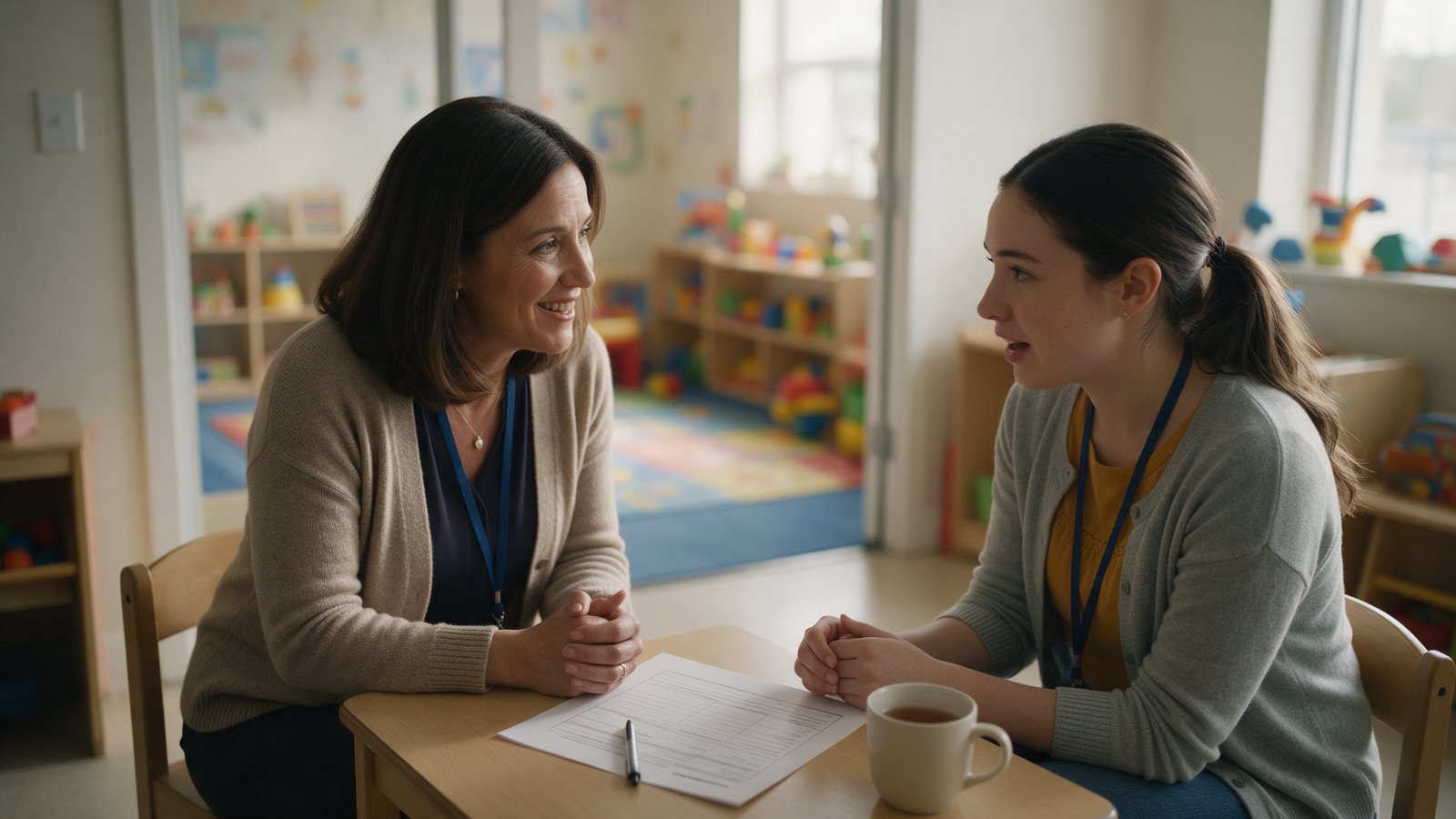
A practical guide for daycare and preschool directors: what to evaluate, how to gather fair evidence, how to run the review meeting and a simple evaluation form you can adapt.
Most daycare directors know which educators are thriving and which are struggling, yet formal staff evaluations often slide to the bottom of the to-do list. When they do happen, they can feel rushed: a form filled in the night before, a short meeting, and a signature. Staff leave unsure what they did well or what to work on, and the director is left wondering whether the process changed anything at all.
A good evaluation does the opposite. It tells each educator clearly what is going well, agrees on one or two things to grow, and gives you a fair record if problems need addressing later. It also signals that you take your team's professional growth seriously, which matters in a sector where keeping good people is hard. This guide walks through what to evaluate, how to gather fair evidence, how to run the conversation and a simple form you can adapt for your center.
Why staff evaluations matter in early childhood settings
Educators shape children's days in hundreds of small moments: how they greet a crying toddler, how they handle a conflict over a toy, how they talk to a worried parent at pick-up. Regular, fair evaluations help you:
- Protect quality of care by spotting gaps in safety routines, supervision or interactions early.
- Support growth by turning vague impressions into specific goals and training.
- Recognize good work so strong educators feel seen and want to stay.
- Keep things fair and consistent, with every staff member assessed against the same expectations.
- Document concerns in a calm, factual way if performance needs to improve.
What to evaluate: five core areas
Keep the criteria short and tied to the role. Most center forms cover some version of these areas:
1. Safety and supervision
- Follows health, hygiene and safety procedures consistently.
- Keeps children within sight and sound and knows group numbers at all times.
- Records incidents, accidents and medication accurately and on time.
2. Interactions with children
- Warm, responsive and patient, at the child's eye level.
- Uses positive guidance rather than threats or shaming.
- Supports language by talking with children, asking open questions and listening.
3. Planning, observation and learning
- Prepares activities that suit the children's ages and interests.
- Observes children and records meaningful notes about their progress.
- Sets up an organized, inviting space and adapts plans when something isn't working.
4. Partnership with families
- Communicates kindly and clearly at drop-off, at pick-up and in messages.
- Shares positive news, not only problems.
- Handles sensitive conversations calmly and involves the director when needed.
5. Teamwork and professionalism
- Reliable with attendance, punctuality and agreed tasks.
- Supports colleagues and contributes to a positive atmosphere.
- Takes part in training and is open to feedback.
How to gather fair evidence
The biggest risk in any evaluation is relying on memory or on one recent incident. Build a fuller picture over several weeks:
- Short, planned observations. Spend 20–30 minutes in the room at different times of day, such as morning arrival, mealtime and outdoor play. Note what you see and hear, not your interpretation.
- Informal check-ins. Brief conversations throughout the year make the formal review less surprising.
- Self-assessment. Ask the educator to rate themselves on the same form before the meeting. The gap between their view and yours is often the most useful part of the conversation.
- Written records. Daily notes, observations of children and incident reports show how carefully someone documents their work.
- Specific examples. For every rating, try to write one concrete example. "Calmly helped two children take turns with the bikes on Tuesday" is far more useful than "good with behavior".
A simple daycare staff evaluation form
You don't need a long document. A one- or two-page form with a clear rating scale works well for most centers:
- Header: educator name, role, room or age group, review period, reviewer.
- Rating scale: for example 1 = needs improvement, 2 = developing, 3 = meets expectations, 4 = exceeds expectations. Define each level in one sentence so every reviewer uses it the same way.
- Five sections matching the core areas above, each with three or four statements, a rating and space for one example.
- Strengths: two or three things the educator does particularly well.
- Goals for the next period: one or two specific, realistic goals, with the support you will provide (training, mentoring, time to plan).
- Educator comments: space for their view, including anything they need from you.
- Signatures and date, plus the date of the next check-in.
Use the same form for everyone in the same role, and review it with your team once a year so it reflects what your center really values.
How to run the review meeting
- Book a quiet time and place. Not during nap supervision, and not in a corridor. Allow 30–45 minutes.
- Start with strengths. Be specific and sincere. Educators remember the tone of the opening.
- Compare views. Go through the self-assessment and your ratings side by side and ask about differences: "You rated yourself a 2 on planning. What makes you say that?"
- Address concerns directly but kindly. Describe the behavior, its effect on children or colleagues and what you need to see instead.
- Agree on goals together. Goals the educator helps choose are far more likely to happen.
- End with next steps. Confirm the support you'll provide and set a date to check progress.
Common mistakes to avoid
- Saving all feedback for once a year, so problems feel like an ambush.
- Judging the whole year by the last two weeks.
- Rating everyone "meets expectations" to avoid difficult conversations.
- Writing vague comments with no examples.
- Setting goals and never following up on them.
- Linking every review to pay, which can make honest self-assessment harder. Many directors keep development conversations and pay decisions separate.
How kidsday can help
Fair evaluations depend on good records, and much of the evidence you need is already created during a normal day. In kidsday, educators record meals, naps, activities, incidents and observations, send daily updates with photos to parents and message families in the app. Their observations also feed the AI Development Report, which turns them into progress reports for each child. Looking at these records together with your own room observations can give you a broader, more balanced picture of an educator's work than memory alone, and a natural starting point for a conversation about documentation and family communication.
Final thoughts
A staff evaluation shouldn't be a test educators dread. Done well, it's a structured conversation about what is working, what to improve and how you will help. Keep the form simple, gather evidence over time, start with strengths and follow up on the goals you agree. Your team will feel more supported, and the children in your care will feel the difference.