
Gentle Día de Muertos activities for babies, toddlers and preschoolers, a safe classroom ofrenda, simple words to explain the tradition and ideas to involve families.
Every year at the end of October, daycare and preschool teachers across Mexico start asking the same questions: which Day of the Dead activities work for children who are only one, two or three years old, how do you build a classroom ofrenda that is safe for little hands, and what do you say when a curious three-year-old asks why there are photos of people who died?
Día de Muertos, celebrated on November 1 and 2, is one of the most meaningful traditions in Mexico and is recognized by UNESCO as part of the world's intangible cultural heritage. It is a joyful, colorful way of remembering loved ones, and young children can take part in it in a way that fits their age. This guide brings together simple explanations, activities by age group, safety tips and ideas for involving families.
How to explain Day of the Dead to young children
Small children understand far more than we think, but they need short, concrete words. A good explanation focuses on remembering and love, not on fear.
- Keep it simple and true: "On these days, many families remember the people they love who have died. They put their photos, flowers and favorite foods on a special table called an ofrenda."
- Avoid confusing euphemisms: phrases like "they went to sleep" or "they went on a trip" can make children afraid of sleeping or of goodbyes. "Died" is clear and, said gently, it is not frightening.
- Follow the child's lead: answer the question they asked, briefly, and let them come back with more questions when they are ready.
- Respect every family: some families celebrate at home, some follow other traditions or beliefs, and some may be grieving a recent loss. Keep the classroom approach warm and general, and let families share as much or as little as they want.
Activities for babies (0 to 12 months)
Babies don't need explanations. What they enjoy is color, sound and texture, so the celebration becomes a sensory experience.
- Orange and purple sensory basket: soft fabrics, scarves and large, safe objects in the colors of cempasúchil (marigold) and papel picado.
- Music time: traditional Mexican songs played softly while the baby explores or is held.
- Looking at pictures together: large, simple images of flowers, papel picado and decorated skulls, with the educator naming colors and shapes.
Activities for toddlers (1 to 3 years)
Toddlers learn with their whole body. Short activities of 5 to 10 minutes, repeated over several days, work better than one long project.
- Marigold petal tray: a low tray with cempasúchil petals to touch, smell, scoop and pour, always under close supervision so nothing goes into the mouth.
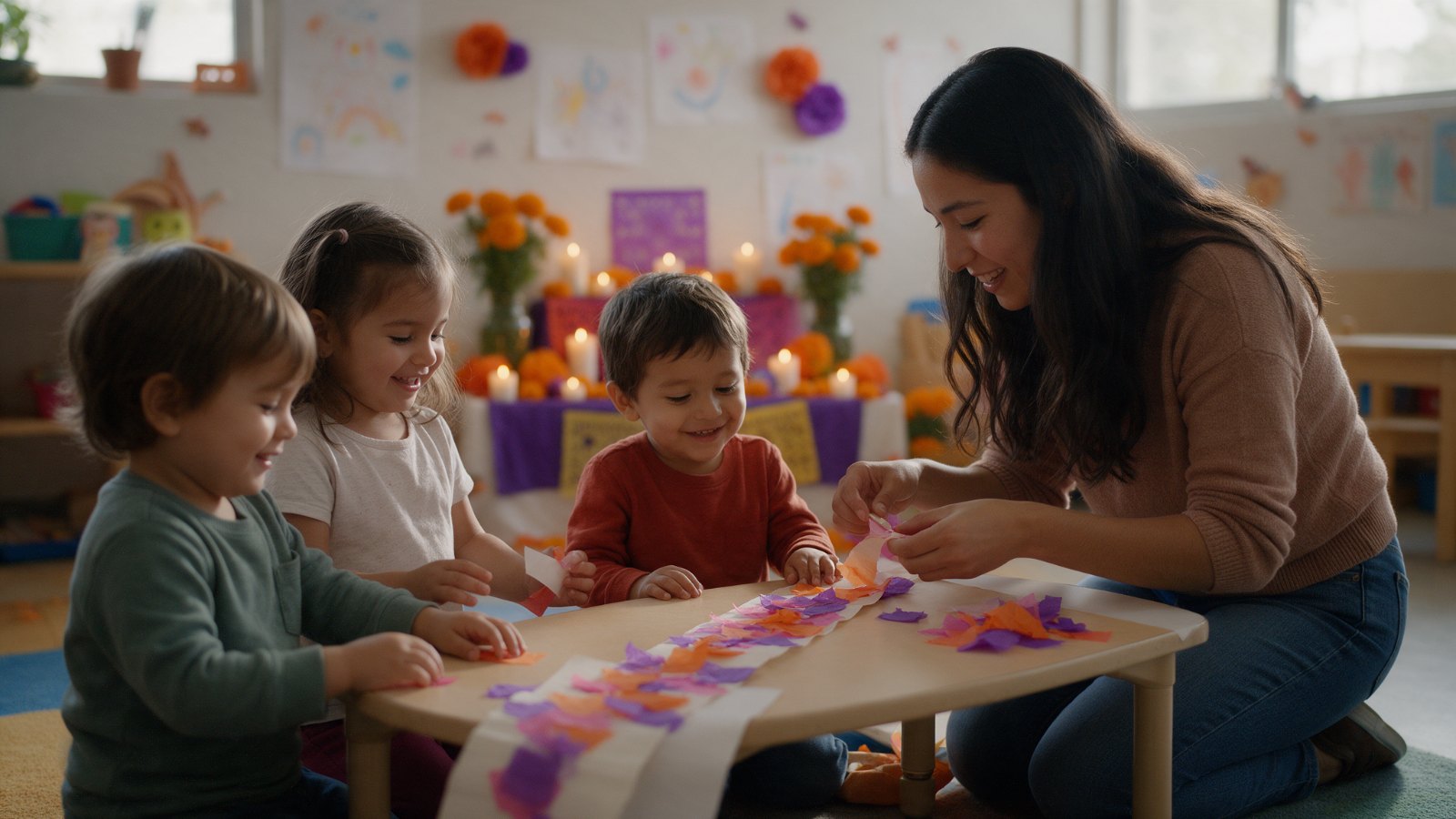
- Tissue paper "papel picado": the adult pre-cuts the shapes and the toddlers glue pieces of colored tissue paper onto a large sheet or a string. It practices fine motor skills and is easy to display.
- Sticker calaveras: large paper skull outlines that toddlers decorate with big stickers, dot markers or finger paint.
- Flower path: a short path of paper flowers on the floor to walk, jump or crawl along, inspired by the marigold paths that guide visitors to the ofrenda.
- Songs and simple words: colors (orange, purple, yellow), "flower", "candle", "photo", "bread". Repeat them during the week.
Activities for preschoolers (3 to 5 years)
Preschoolers can understand the meaning of the tradition, take part in planning and talk about their own memories.
- A classroom ofrenda: build it together with the children. Each level can hold something they choose: paper flowers, drawings, play-dough "pan de muerto" and photos that families decide to share.
- "Someone I remember" drawing: children draw a person or a pet they remember, or a person they love who is alive if they prefer. The goal is talking about feelings, never forcing a story.
- Play-dough pan de muerto: shaping the round bread and its "bones" builds hand strength and opens conversations about family recipes.
- Story time: picture books about Día de Muertos and about remembering loved ones, followed by simple questions: "What did the family put on the ofrenda? Why?"
- Counting and patterns: counting flowers, making color patterns with petals or paper, sorting objects by size for each level of the ofrenda.
- Catrina or catrín day: simple costumes or face painting, only with written permission from families and using products suitable for children's skin.
Safety tips for a classroom ofrenda
An ofrenda in a room full of small children needs a few adjustments.
- No real candles or incense: use battery-operated LED candles and keep copal or incense for home.
- Place it out of reach: a stable, low-traffic spot, with heavy or breakable items on the highest level.
- Watch small items: sugar skulls, candies, beads and decorations can be choking hazards for children under four. Use paper or felt versions in the classroom.
- Food and allergies: if real food is offered, check every child's allergies first and keep it as decoration, not as a snack.
- Flowers: keep vases out of reach and supervise any activity with real petals.
How to involve families
Day of the Dead is a family tradition, and families are often happy to help when they are invited with care.
- Send a short note a week before, explaining the activities, the date of the ofrenda and that taking part is optional.
- Invite them to share a photo, a recipe, a song or a story, only if they wish.
- Ask about grief and beliefs: let families tell you privately if their child has recently lost someone close, or if they prefer that their child does not take part, and plan an alternative activity.
- Show the result: photos of the finished ofrenda and of the children working on it help families feel part of the celebration.
Planning and sharing it with kidsday
If your center uses kidsday, the AI Lesson Planner can help you organize the week's activities by age group, and the parent app makes it easy to share photos of the ofrenda and short updates about each day's activity with families. You can also use in-app messaging to send the invitation note and to collect family photos or recipes, so everything stays in one place.
Final thoughts
Día de Muertos is a wonderful opportunity to teach young children about family, memory and culture with color and joy. Keep explanations simple, choose short activities that match each age, adapt the ofrenda for safety and invite families with respect for their beliefs. Most of all, follow the children: their questions, drawings and stories will show you how they are making sense of this beautiful tradition.