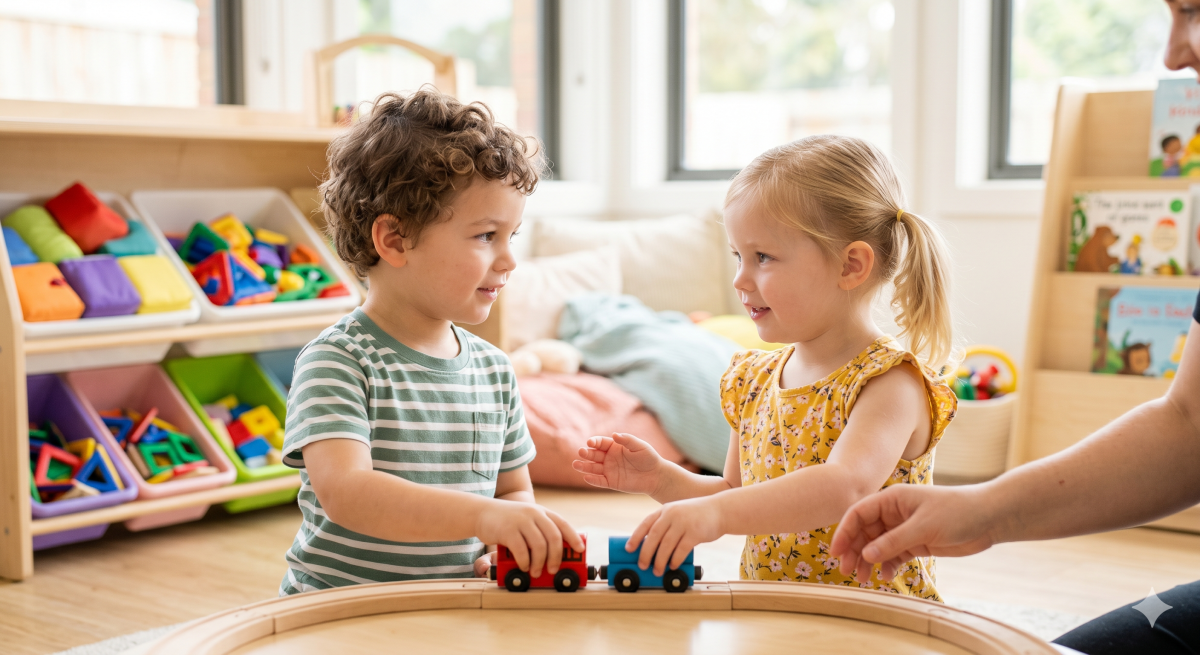
Many parents and educators believe that by forcing a child to hand over a toy immediately, they are teaching generosity. In reality, this often triggers a "scarcity mindset." The child feels their play is insecure, leading them to cling even harder to their possessions in the future.
The Shift: Sharing should be a voluntary social interaction, not a forced surrender.
2. The "Long Turn" Strategy
Instead of using a timer that abruptly ends a child’s engagement, try the "Until You’re Finished" technique:
-
Let the first child finish: Allow them to play until they are genuinely done.
-
Support the waiting child: Acknowledge their frustration. "I see you really want that car. Ben is using it right now. As soon as he is finished, it’s your turn. What should we do while we wait?"
-
The Result: The child with the toy learns that adults respect their work, making them more likely to give it up willingly later. The waiting child learns vital self-regulation and patience.
3. Apologies: From Scripted Words to Genuine Empathy
Forcing a child to say "I'm sorry" while they are still mid-tantrum or angry teaches them that words are a "get out of jail free" card, rather than a reflection of remorse.
-
Focus on the Victim First: Instead of lecturing the "aggressor," attend to the child who was hurt. "Oh, that hurt your arm. I’m here to help." This models empathy.
-
Making Amends (The "Repair"): Once everyone is calm, ask: "Your friend is sad because the tower fell. What can we do to help him feel better?"
-
Action over Words: A child bringing a tissue, a cold pack, or a different toy is a much more profound lesson in empathy than a muttered, forced "sorry."
4. Cooperation: The Power of "We"
Cooperation is a skill built through daily contribution, not lectures.
-
Collaborative Play: Encourage activities with no single winner, such as building a giant fort or completing a large puzzle.
-
The "Helper" Identity: Involve children in "adult" tasks. "I’m setting the table; can you be my teammate and put the napkins down?"
-
Specific Praise: Instead of "Good job," use descriptive feedback: "You two figured out how to carry that heavy box together! That’s great teamwork."
5. Effective Communication: What to Say Instead of Commands
To change a child's behavior, we must first change the language we use to guide them. Here are specific ways to communicate in common social situations:
-
For Sharing Toys: Instead of saying, "Give it to her now, don't be selfish!" try: "Let Sarah know with your words when you are finished with your turn, so she can have her turn next." This gives the child a sense of agency and control over their play.
-
For Physical Conflicts: Instead of the standard order, "Say sorry right now!" try: "Look at your friend’s face; he looks very sad because he was hurt. What can we do to help him feel better?" This shifts the focus from a forced script to actual accountability and care.
-
For Group Work: Instead of shouting, "Stop pushing each other!" try: "It looks like you both have the same great idea for this tower. How can you work together so you both have enough space to build?"
-
For Property and Boundaries: Instead of, "You have to share everything!" try: "This is your special toy, and I understand you love it. Are you ready to let your friend use it for a little bit, or do we need to wait a few more minutes?"
Early childhood education is a marathon, not a sprint. When we move away from forcing behaviors through power struggles, we begin to build an internal moral compass in our children.
Поврзани Постови

Friday, 30 May 2025
How to Create a Meaningful and Modern Activity in Preschool?
Monday, 20 April 2026
Drawing: The Invisible Language of Early Childhood

Friday, 24 January 2025
Kidsday at BETT UK 2025: Connecting Education and Technology✨

Wednesday, 29 May 2024
The Importance of Training Staff in Daycare Centers!

Monday, 22 July 2024