

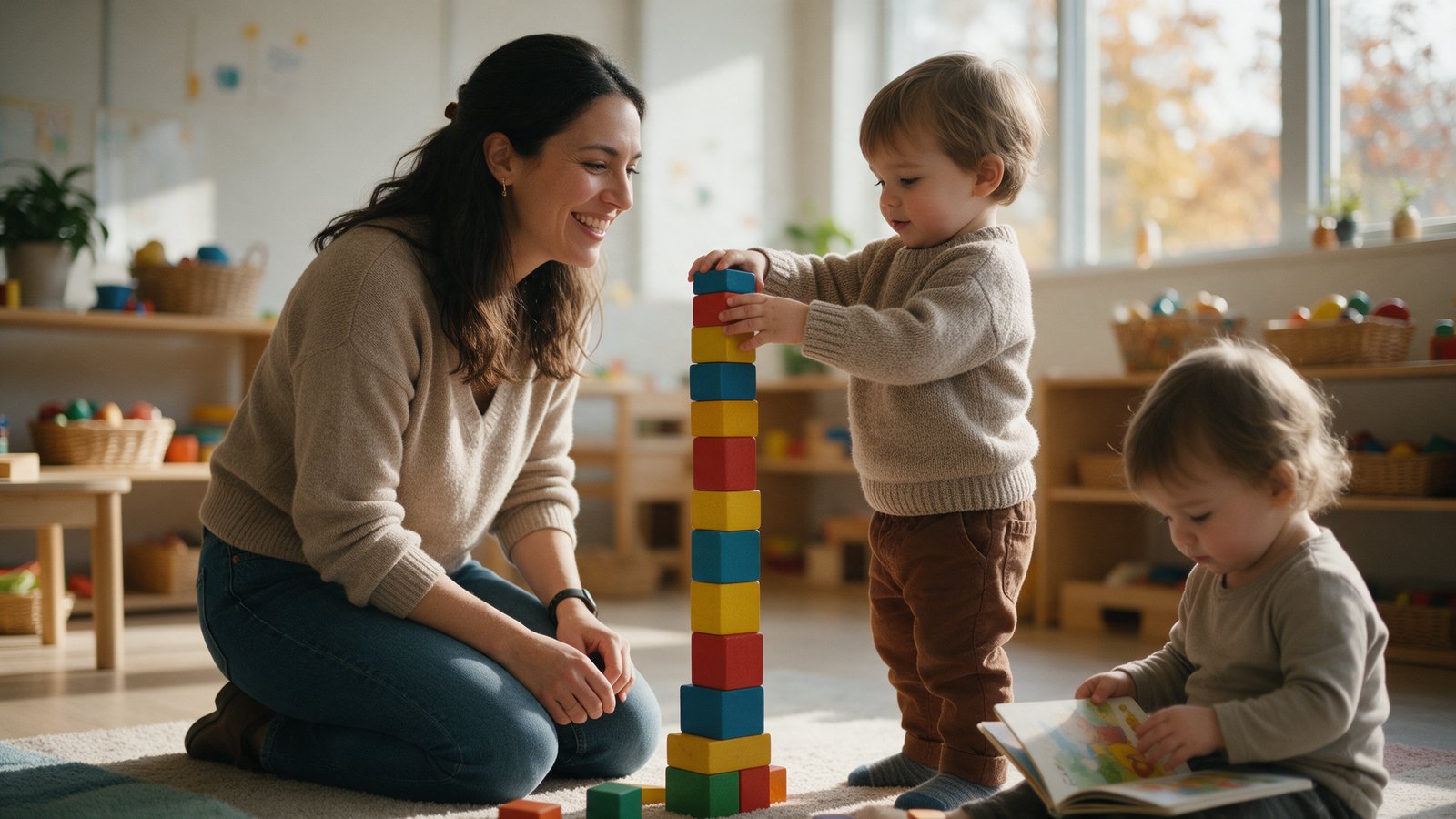
A calm, practical guide to the skills most children show around 2, 2½ and 3 years, how to support them at home and in daycare, and the signs worth raising with your pediatrician.
Somewhere between the second and third birthday, many parents start comparing. A quick search for "2 year old milestones" brings up long lists that raise more questions than they answer. Is my child on track? Should I be doing more?
Educators hear the same worries every week. The good news is that milestones are not a test your child passes or fails. They are a rough map of the skills most children show around a certain age, and they work best as a starting point for a conversation with the people who know your child well: you, the daycare team and your pediatrician. This guide explains what to look for, how to support each area in everyday life, and when to ask for a professional opinion.
What a milestone really is
A milestone is a skill that most children of a given age can do, such as saying two words together or walking up stairs. Pediatric milestone checklists describe what most children do by a certain age, not what the average child does, so a child who has not shown a skill yet is not automatically behind. Development also comes in bursts, so a quiet month is often followed by a leap.
Keep three things in mind:
- Look at the whole picture. One missing skill matters less than the overall direction: is your child learning new things month by month?
- Context matters. Children who hear more than one language, were born early or have just been through a big change (a new sibling, starting daycare, a move) may show some skills a little later.
- Loss of skills is different. A child who stops doing something they could do before should always be checked by a pediatrician, at any age.
Around 2 years: what many children do
Social and emotional
- Notices when someone is hurt or upset and may stop to look.
- Looks at your face to see how to react in a new situation.
Language and communication
- Says at least two words together, such as "more milk".
- Points to things in a book when you ask, and to at least two body parts.
- Uses gestures beyond waving and pointing, such as nodding or blowing a kiss.
Thinking and movement
- Holds something in one hand while using the other, for example holding a box and taking off the lid.
- Plays with more than one toy at the same time.
- Kicks a ball, runs, and walks up a few stairs with or without help.
- Eats with a spoon.
Around 2½ years: what many children do
- Plays next to other children and sometimes with them.
- Says around 50 words and puts two or more words together with an action word, such as "doggy run".
- Uses words like "I", "me" and "we".
- Follows simple routines, like helping to tidy toys when asked, and follows two-step instructions such as "Put the toy down and close the door".
- Pretends, for example feeding a doll with a block.
- Twists things with the hands, like turning a doorknob or unscrewing a lid, and turns book pages one at a time.
- Jumps off the ground with both feet and takes off some clothes without help.
Around 3 years: what many children do
- Calms down within about ten minutes after a parent leaves at daycare drop-off.
- Joins other children to play and takes part in a back-and-forth conversation.
- Asks "who", "what", "where" or "why" questions and says their first name when asked.
- Talks well enough that people outside the family understand most of what they say.
- Draws a circle after you show how, and strings large beads.
- Puts on some clothes without help and uses a fork.
How to support development at home and in daycare
Toddlers learn through ordinary moments far more than through special programs. A few habits make a big difference:
- Talk through the day. Name what you see and do: "You're pouring the water. Now the cup is full." Add one word to what your child says: if they say "car", you say "red car".
- Read together daily. Let your child point, turn pages and name pictures. Ask "What is happening here?"
- Offer real jobs. Carrying a napkin to the table, putting socks in the basket or wiping a spill builds hand skills, independence and pride.
- Make time to move. Daily outdoor play with running, climbing, jumping and throwing supports balance and coordination.
- Play pretend. A toy kitchen, dolls or a cardboard box encourage language, imagination and taking turns.
Educators can mirror the same ideas in the group: songs with actions, simple two-step instructions during tidy-up, small-group book time and plenty of free play with peers.
When to talk to your pediatrician
Milestones are not a diagnosis, and neither this article nor any checklist can tell you whether a child has a delay. Your pediatrician can look at your child's development as a whole and, if needed, refer you to a specialist such as a speech therapist. Book a conversation if you notice, for example:
- Your child has lost words or skills they used to have.
- Around 2 years, your child does not use two-word phrases, does not copy actions or words, or does not follow simple instructions.
- Around 3 years, your child does not play pretend, does not try to speak in short sentences, or is very hard to understand.
- You have a feeling that something is not right, even if you can't name it.
You don't need to wait for the next routine checkup. Early support works best, and asking is never a waste of anyone's time.
Partnering with your child's daycare
Educators spend many hours with your child in a group setting, so they often notice things you don't see at home, and the reverse is true too. Share what you observe, ask how your child plays and communicates with other children, and agree on small goals you can practice in both places. If educators raise a concern, take it as useful information rather than a judgment. Many centers use a short milestone checklist to structure their observations; the free Developmental Milestone Checklist in the Tools section of kidsday.com lets you choose a child's age and an area (motor skills, language and communication, cognitive, or social and emotional), tick off what the child is doing and turn it into a draft observation note for the family. It is based on published milestone guidance and is not a screening tool.
Centers that use kidsday can make this sharing part of everyday life. Educators record observations and share daily updates with photos and notes in the parent app, parents and educators can message each other in the app, and the AI Development Report turns educators' observations into status, monthly or semester reports that show a child's progress, areas where they may need more support, and suggested activities to try. That gives families and educators a shared picture to bring to a conversation with the pediatrician when needed.
Final thoughts
Between 2 and 3, children change at an astonishing pace: from first word pairs to questions, from parallel play to real friendships. Use milestones as a gentle guide, not a scorecard. Celebrate what your child can do, give them plenty of chances to practice through play and conversation, stay in close contact with their educators, and whenever something worries you, talk to your pediatrician early.