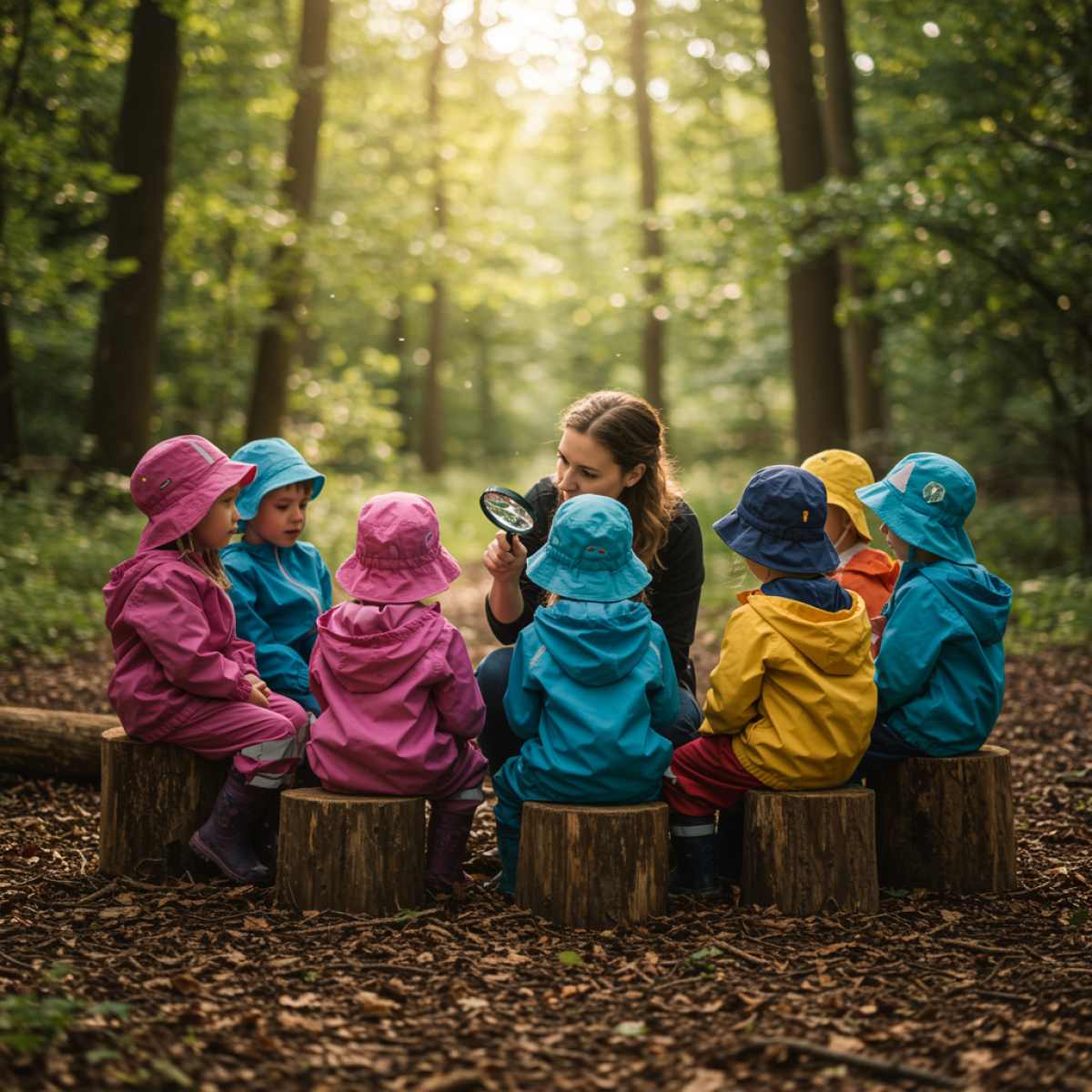
In early childhood education, the movement toward "forest schools" and outdoor learning is becoming a necessity. Learning outside four walls isn't just a walk; it’s a living laboratory that stimulates every one of a child's senses.
-
Development of Motor Skills: Unlike the flat floors of a classroom, natural terrain is uneven. Climbing trees, walking over stones, and running through grass develop balance, coordination, and physical strength naturally.
-
Reduction of Stress and Anxiety: Studies show that exposure to natural light and fresh air lowers cortisol levels (the stress hormone) in children. Nature has a calming effect that particularly helps children with excess energy or difficulty focusing.
-
Fostering Scientific Curiosity: Outside, every overturned stone reveals a new world. Children learn biology by watching insects, physics by playing with falling leaves, and math by counting pinecones. This makes knowledge concrete and unforgettable.
-
Socialization and Collaboration: The open environment encourages group play. When children build a "shelter" from branches or cross a puddle, they must communicate, negotiate, and help one another, strengthening their social intelligence.
Nature provides a sensory-rich environment that no indoor classroom can replicate. By removing the physical barriers of walls, we allow children to explore, take risks, and develop a deep-rooted love for the world around them.
Related Posts

Wednesday, 07 February 2024
The Power of Evidence: Ensuring Attendance in Kindergarten with kidsday!

Wednesday, 28 January 2026
Beyond the Timer: New Research Says How Your Child Uses Screens Matters Most
Wednesday, 03 April 2024
Enhancing Learning Through Project-Based Learning: Practical Tips for Educators!

Thursday, 28 March 2024
kidsday Transforms LET Center's Communication!

Friday, 07 March 2025