
How Interactive Projectors, Short Educational Content, and Hands-On Activities Can Transform Technology Use in Daycares and Early Learning Centers
The presence of a television (TV) in daycares and early learning centers has become a widespread habit, but one that carries significant risks for child development. Although TVs are often used as a quick fix to keep children quiet and contained, child development experts and neuroscientists warn that this is a critical mistake. At this stage, television does not educate, it simply paralyzes a child's attention, robbing them of precious developmental time.
The risks of traditional TV exposure in preschool environments are directly tied to how a young child's brain functions. Fast-paced television broadcasts and cartoons create sensory overload. Rapidly changing images and loud sound effects lock children onto the TV screen, leaving no space for deep processing, critical thinking, or creative play. Furthermore, whenever the TV is on, verbal interaction in the room drops drastically. Preschoolers develop language skills through direct, two-way conversations with caregivers and peers; the silence imposed by a TV screen deprives them of essential language milestones. Sitting passively in front of a TV also eliminates physical movement, drawing, and hands-on play, activities fundamental to fine and gross motor skills.
However, the solution isn't necessarily banning technology altogether, but radically changing how it is used: shifting from a passive TV screen that children stare at, to an interactive projector that fosters shared experiences and exploration.
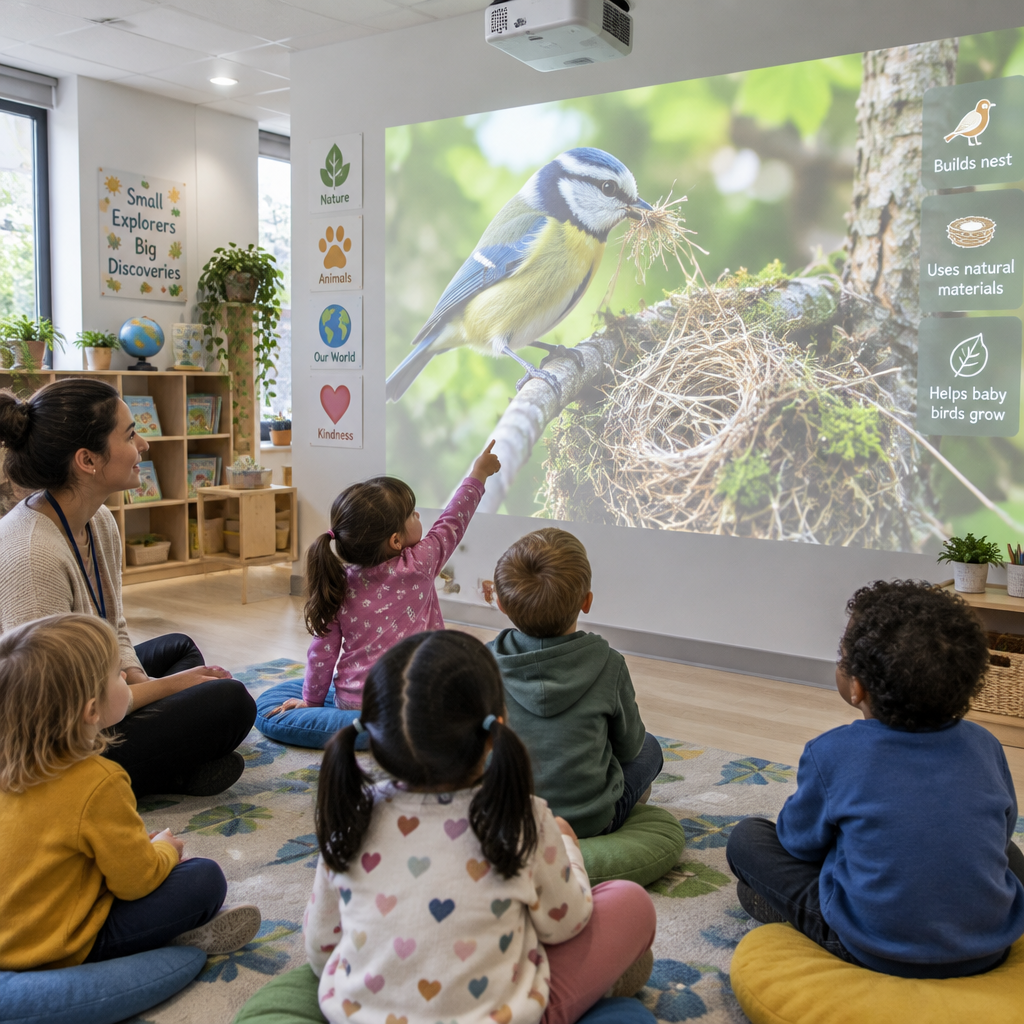
In this context, using a projector for short educational documentaries offers a completely different approach compared to conventional TV. Unlike a TV set, which acts as a static focal point where children sit glued to the screen, a projector can transform the physical environment of the entire classroom. A teacher can project life, sized visuals onto a large wall or even the floor, showing footage from nature, space, or the underwater world. This creates an immersive experience where children feel like active explorers stepping inside a new environment, rather than passive TV viewers.
To ensure this tool remains genuinely educational, documentaries should never be played like a full-length movie or left running endlessly in the background as TV often is. Instead, teachers can play short snippets lasting just 3 to 5 minutes, such as showing how a bird builds its nest or how a flower blooms and then pause the projection. At that moment, the room transforms into a interactive group discussion where children ask questions, share observations, and form hypotheses.
Additionally, a projector can be seamlessly combined with physical movement and creative arts. Children can be invited to imitate the movements of animals shown in the documentary, step on "stepping stones" projected onto the floor, or paint and mold with clay while inspiring natural landscapes illuminate the wall behind them.
Ultimately, technology in early childhood education should never function as a "digital babysitter" meant to keep children quiet and motionless. While traditional television fosters passivity, isolation, and cognitive fatigue, a projector paired with carefully selected documentaries opens up room for dialogue, physical activity, and natural curiosity. Replacing the static TV screen with the dynamic, interactive light of a projector means restoring children's right to explore the world with all their senses, turning technology from a subtle harm into a powerful educational ally.