
Why letter knowledge matters for later reading, how to teach letter names and sounds together, why picture letters help, and simple alphabet games for 3–6 year olds at home.
Many children start pointing at letters long before school: the first letter of their name on a door, a big M on a shop sign. That curiosity is the best starting point for learning the alphabet at home, and it needs no worksheets or pressure, just short, playful moments.
Here is what research says about why letters matter, how to teach letter names and sounds together, and simple games for 3–6 year olds.
Key takeaways
- Knowing the names and sounds of letters is one of the strongest early signs of later reading.1
- Teach a letter's name and its sound together: children use letter names to work out letter sounds.3
- Letters drawn as part of a picture are easier to remember.4
- Letters alone don't make a reader, so mix them with rhymes, talk and shared books.2
Why letters matter
The US National Early Literacy Panel reviewed about 500 research articles on early literacy. Alphabet knowledge, meaning the names and sounds of printed letters, was one of six early skills with medium to large links to later literacy, alongside phonological awareness (hearing the sounds in words) and writing one's own name.1
Teach names and sounds together
A letter has a shape, a name and a sound. Children learn best when they meet all three at once: "This is M. It says mmm, like at the start of Mama." In many alphabets a letter's name contains its sound, and children use what they know about the name to work out the sound.3
- Start with their name: the letters of their own name, and of words like Mama and Papa, mean the most to them.
- Say the sound clearly: keep it short and crisp, without adding an extra vowel after it.
- A few letters at a time: two or three new letters a week, with plenty of repetition of the ones they already know.
- Match home and kindergarten: ask which letter shapes and letter names your child's kindergarten uses, so home and group say the same thing.
Turn letters into pictures
Draw an S as a snake, turn a B into a butterfly, or let your child decorate a big letter with drawings of things that start with its sound. The picture gives the shape a story that helps it stick.
What the research says
In a study with 36 English-speaking preschoolers (average age 5 years 2 months) learning 10 Hebrew letters, letters drawn inside pictures of objects with a similar shape were learned in fewer trials, confused less often and remembered better a week later than letters shown with the same objects drawn differently.4
A meta-analysis of alphabet teaching found that direct teaching improves letter knowledge, but found little evidence that it carries over on its own to early reading or spelling.2 That is why letters work best alongside rhymes, conversation and books.
Alphabet games for home
- Letter hunt: pick a letter of the day and find it on packages, signs and book covers.
- I spy with sounds: "I spy something that starts with mmm." Take turns, so your child gets to be the one who chooses.
- Sound basket: collect a few toys that begin with the same sound. Use only objects too large to swallow, and stay close.
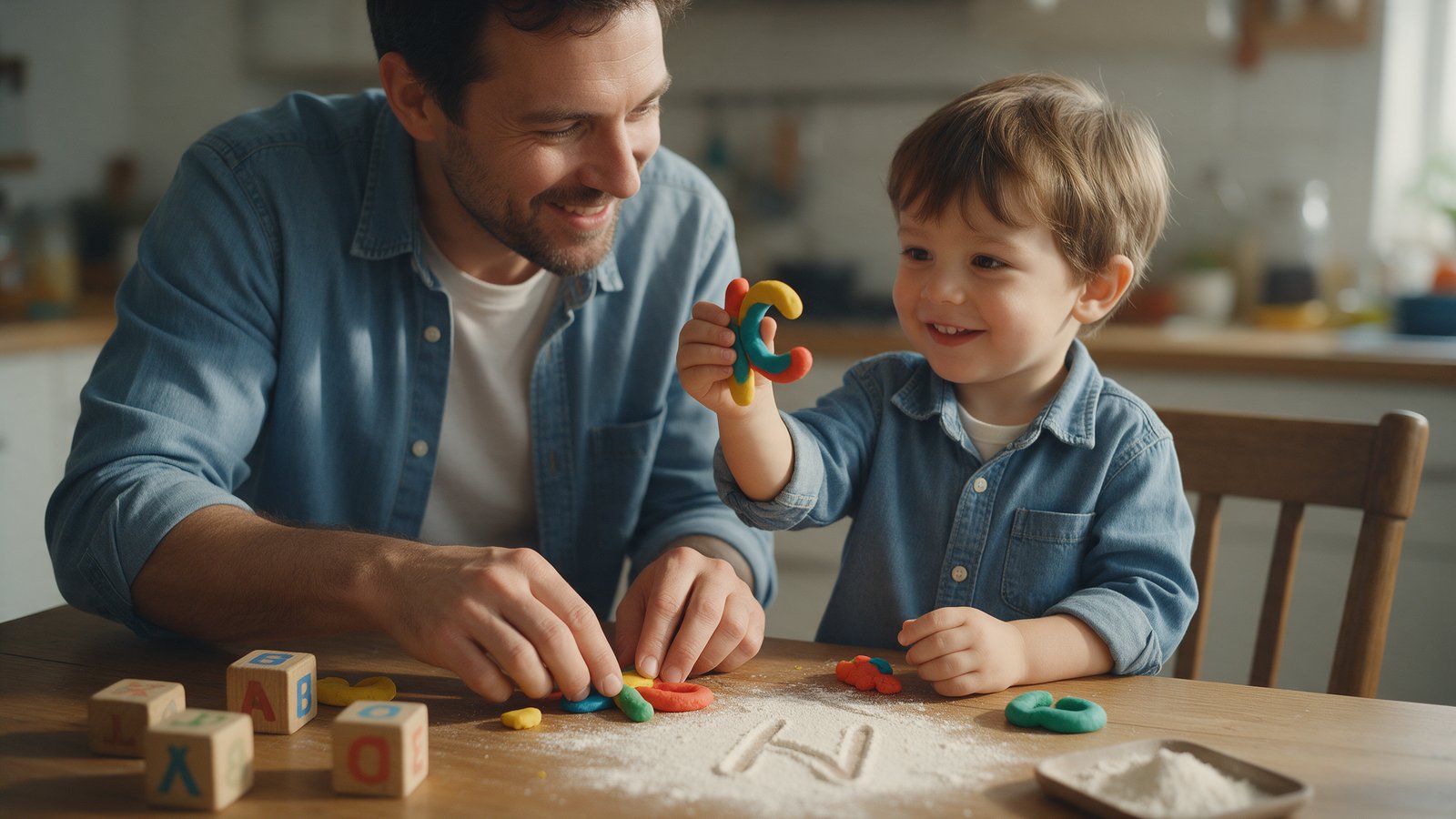
- Trace and build: trace letters in sand or flour, with a wet finger on a chalkboard, or build them from playdough and sticks.
- Read together: while you share a book, point to the title and to a letter your child knows.
Keep it short and fun. If your child loses interest, stop and try again another day: children learn letters at very different ages. If you have concerns about your child's speech, hearing or development, talk to your pediatrician.
Practise letters with Alphabet by kidsday
Alphabet by kidsday is a learning app for 3–6 year olds with the child's own alphabet, first words and finger tracing, and a native voice in your child's language. It has 8 games with 10 levels in every game, no ads, and works offline. It's free to start with the first 10 letters and 4 games. Tracing practises letter shapes, a warm-up for pencil and paper, and the app works best in short sessions, with you beside your child.
Alphabet by kidsday on the App Store · Alphabet by kidsday on Google Play
New: Read by kidsday, for first steps in reading (sounds, syllables, words and little books), is now available: App Store · Google Play.
Final thoughts
You don't need a curriculum to teach the alphabet. Start with your child's name, say names and sounds together, turn letters into pictures and games, and read together every day. A few minutes of play, repeated often, adds up.
Sources
- National Early Literacy Panel. Developing Early Literacy: Report of the National Early Literacy Panel. National Institute for Literacy, 2008. eric.ed.gov/?id=ED508381
- Piasta SB, Wagner RK. Developing early literacy skills: a meta-analysis of alphabet learning and instruction. Reading Research Quarterly, 2010. doi.org/10.1598/RRQ.45.1.2
- Treiman R, Tincoff R, Rodriguez K, Mouzaki A, Francis DJ. The foundations of literacy: learning the sounds of letters. Child Development, 1998. eric.ed.gov/?id=EJ578119
- Shmidman A, Ehri LC. Embedded picture mnemonics to learn letters. Scientific Studies of Reading, 2010. doi.org/10.1080/10888430903117492