

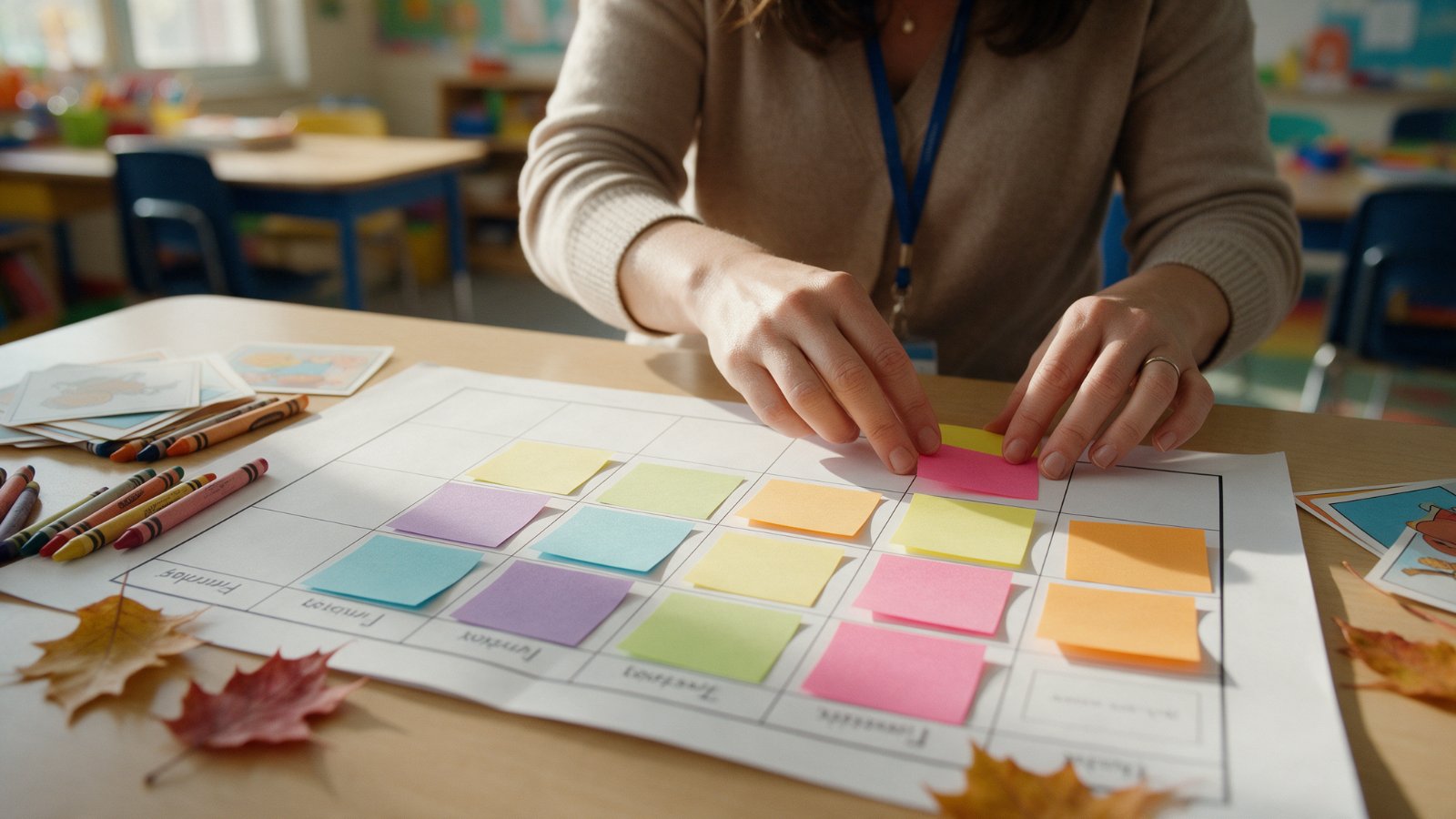
A simple weekly preschool lesson plan template with all the key sections, a filled-in example week, and practical tips for flexible, observation-based planning.
Every educator knows the feeling: Monday morning arrives, the children are coming through the door, and you are still deciding what the week should look like. A clear weekly lesson plan takes that pressure away. It gives your days a shape, helps you prepare materials in advance, and makes sure every area of development gets attention, not just the activities that come to mind first.
The good news is that a useful weekly plan does not need to be long or complicated. In this guide, you will find a simple template you can adapt for any preschool or kindergarten group, a filled-in example week, and practical tips to keep your planning flexible and grounded in what your children actually need.
Why a Weekly Lesson Plan Helps
A weekly plan sits between the big picture of your yearly curriculum and the moment-to-moment reality of the classroom. It helps you:
- Stay balanced: see at a glance whether language, math, movement, creativity and social skills are all covered.
- Prepare ahead: gather materials before the week starts instead of searching for them mid-activity.
- Work as a team: co-teachers, assistants and substitutes know what is planned and why.
- Communicate with families: share the theme so parents can continue the conversation at home.
- Reflect and improve: look back at what worked and use it to plan the following week.
The Weekly Lesson Plan Template
Use these sections as your template. You can keep them in a notebook, a shared document or a digital planner. What matters is that the structure stays the same each week so planning becomes a habit.
1. Theme
Choose one theme that connects the week's activities, such as seasons, animals, family, or transport. A good theme comes from children's interests and from the world around them.
2. Learning goals by developmental area
Write one or two simple goals for each area:
- Language and communication: new words, listening, storytelling.
- Early math and thinking: counting, sorting, patterns, comparing sizes.
- Physical development: fine motor skills (hands and fingers) and gross motor skills (whole body).
- Social and emotional: sharing, taking turns, naming feelings.
- Creativity and exploration: art, music, curiosity about nature.
3. Daily circle time
Plan a short opening each day: a greeting song, a conversation about the theme, and a question that invites children to share their ideas.
4. Small-group activities
List one focused activity per day that you lead with a few children at a time. This is where you can observe closely and adjust the challenge for each child.
5. Learning centers
Note what you will add to each center (reading corner, construction, pretend play, art, sensory table) so children can explore the theme independently.
6. Outdoor and movement
Include daily outdoor time and at least one planned movement game, dance or obstacle course.
7. Stories and songs
Choose two or three books and a few songs or rhymes connected to the theme. Repetition across the week helps children learn new words.
8. Materials
Write a simple checklist of everything you need to prepare, buy or collect.
9. Differentiation
Plan how you will support children who need more help (simpler steps, visual cues, one-to-one time) and how you will extend learning for children ready for more challenge.
10. Observation notes
Leave space to record what you notice: who mastered a new skill, who needed support, what sparked curiosity.
11. Family connection
Add one idea families can try at home, such as a question to ask at dinner or something to collect on a weekend walk.
Example Week: "Autumn Leaves"
Here is how the template might look for a group of four-year-olds:
- Theme: Autumn leaves.
- Goals: learn words such as crunchy, colorful and falling; sort leaves by color and size; practice cutting and gluing; take turns during group games; notice changes in nature.
- Circle time: Monday, "What happens to trees in autumn?"; Tuesday, leaf colors; Wednesday, counting leaves; Thursday, animals preparing for winter; Friday, sharing our leaf art.
- Small groups: Monday, leaf hunt and sorting; Tuesday, leaf rubbings with crayons; Wednesday, counting and matching leaves to numbers; Thursday, making a leaf collage; Friday, creating a group story about a leaf's journey.
- Learning centers: leaves and magnifying glasses at the science table, pinecones and acorns in the sensory bin, a pretend "forest café" in the role-play area, autumn books in the reading corner.
- Outdoor and movement: leaf collecting walk, "falling leaves" dance with scarves, jumping into a leaf pile.
- Stories and songs: two picture books about autumn, a falling-leaves song with actions.
- Materials: collected leaves, paper, crayons, glue, child-safe scissors, scarves, number cards.
- Differentiation: pre-cut shapes for children still developing scissor skills; a sorting challenge with three categories instead of two for children ready for more.
- Observation focus: scissor grip, counting to ten, use of new vocabulary.
- Family connection: invite families to collect three different leaves on a walk and talk about their colors.
Tips for Planning That Works
- Link goals to your framework: connect each goal to your national or local early-years curriculum framework. This keeps planning purposeful and makes reporting easier.
- Plan from observations: use last week's notes to decide what comes next. If several children were fascinated by insects, follow that interest.
- Keep it flexible: a plan is a guide, not a script. If an activity is not working or children are deeply engaged in something else, adapt.
- Balance active and calm: alternate energetic activities with quiet ones to match children's attention and energy levels.
- Reuse what works: save successful plans so you can adapt them next year rather than starting from scratch.
Making Planning Easier With Digital Tools
Many educators find that planning on paper becomes hard to share and easy to lose. With kidsday, educators can use the AI Lesson Planner to create weekly plans around a theme and age group, then adjust them to fit their group. Throughout the week, observations can be recorded in the app, and the AI Development Report can turn those notes into clear progress reports, so planning, observing and reporting stay connected.
Final Thoughts
A weekly lesson plan is one of the simplest ways to bring calm and purpose to your classroom. Start with the template, keep it realistic, and let your observations of the children guide each new week. Over time, planning will take less effort and your days will feel more intentional, for you and for the children in your care.